

Charles Ives, 4 July
American Primitive

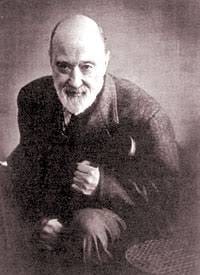
Charles Ives (1874-1954) wrote A Symphony: New England Holidays between 1904 and 1913. The third movement is Fourth of July and depicts in sound Ive’s memories of street bands and the chaotic revelry of celebrations in his small town of Danbury in New England in the 19th Century. It requires two conductors due to Ive’s technique of clashing sound sources. Ives wasn’t exactly a modernist, he wrote he heard and his music stands alone. American musical themes jump in and out of the hazy impressionism. The film of Bernstein’s rendition shows children’s reactions; would modern kids listen so intently to such a chaotic clash?
“It’s a boy’s Fourth—no historical orations—no patriotic grandiloquence by grown-ups—no program in his yard” wrote Ives. “But [the boy] knows what he’s celebrating—better than some of the county politicians—and he celebrates in his own way—with a patriotism nearer kin to nature than jingoism.
It starts in the quiet of the midnight before and grows raucous with the sun … cannon on the green, village band on Main St., firecrackers under tin cans, shanks mixed on cornets, strings around big toes, torpedoes, church bells, lost-finger, fifes, clam chowder, a prize-fight, burnt shins, parades (in and out of step), saloons all closed (more drunks than usual), baseball game (Danbury All-Stars vs. Beaver Brook Boys), pistols, mobbed umpire, Red White and Blue, runaway horse—and the day ends with the sky-rocket over the church steeple, just after the annual explosion sets the Town Hall on fire.”
Charles Ives lived a quiet and conservative life in Danbury and New York whilst working in the insurance industry. Few of his collegues knew that he would compose his strange pieces after he returned from work each evening. Ives developed a completely new musical language where the marching bands of his small-town upbringing clashed with each other on the street parades in a kind of chaotic symbiosis of his own devising. He devised a way to write these clashes and interruptions into musical representation. During his lifetime he received little recognition but his reputation grew slowly until the 1950s-60s when his compositions were accepted and recorded. Belatedly, Ive’s strange works were recognised as expressions of the American small town experience. Stravinsky was particularly voluable. In 1966 he wrote: “[Ives] was exploring the 1960s during the heyday of Strauss and Debussy. Polytonality; atonality; tone clusters; perspectivistic effects; chance; statistical composition; permutation; add-a-part, practical-joke, and improvisatory music: these were Ives’s discoveries a half-century ago as he quietly set about devouring the contemporary cake before the rest of us even found a seat at the same table.”
In 1927 Ives halted his amateur composing because, as he said to his wife, “nothing sounds right” and the rest of his life was spent revising his earlier works.
Ives shows the quiet power of independent thought and action outwith mainstream artistic and cultural norms. He is an authentic primative American.
Check out The Unanswered Question, the rest of the Fourth Symphony, Three Places in New England, The Housatonic at Stockbridge.
Happy Birthday America in all your chaos and contradictions and beauty
if you had not explained before what … this is about I would have shook my head when listening to it and questioned our civilization. Thanks for that.